Most conversations about pricing maturity start with technology. Which platform. Which AI model. Which dashboard. But in my experience leading pricing software implementations, the real maturity journey has very little to do with software selection and almost everything to do with what happens inside the organization once the decision to gain control of pricing execution has been made.
Pricing, however, is not just a systems challenge. It is a business risk. When pricing execution lacks control, organizations expose themselves to margin leakage, inconsistent deal outcomes, and unnecessary financial risk.
After working through multiple deployments across B2B manufacturing and distribution environments, I have observed a repeatable pattern in how organizations evolve their pricing capabilities. I call it the CX Ops Pricing Maturity Model, a three-stage framework that maps the transformation toward controlled pricing execution, not from the vendor’s perspective, but from the operations team responsible for making it work.
The CX Ops Pricing Maturity Model
The model has three stages, each defined not by the software’s capabilities but by the organization’s operational readiness to use them:
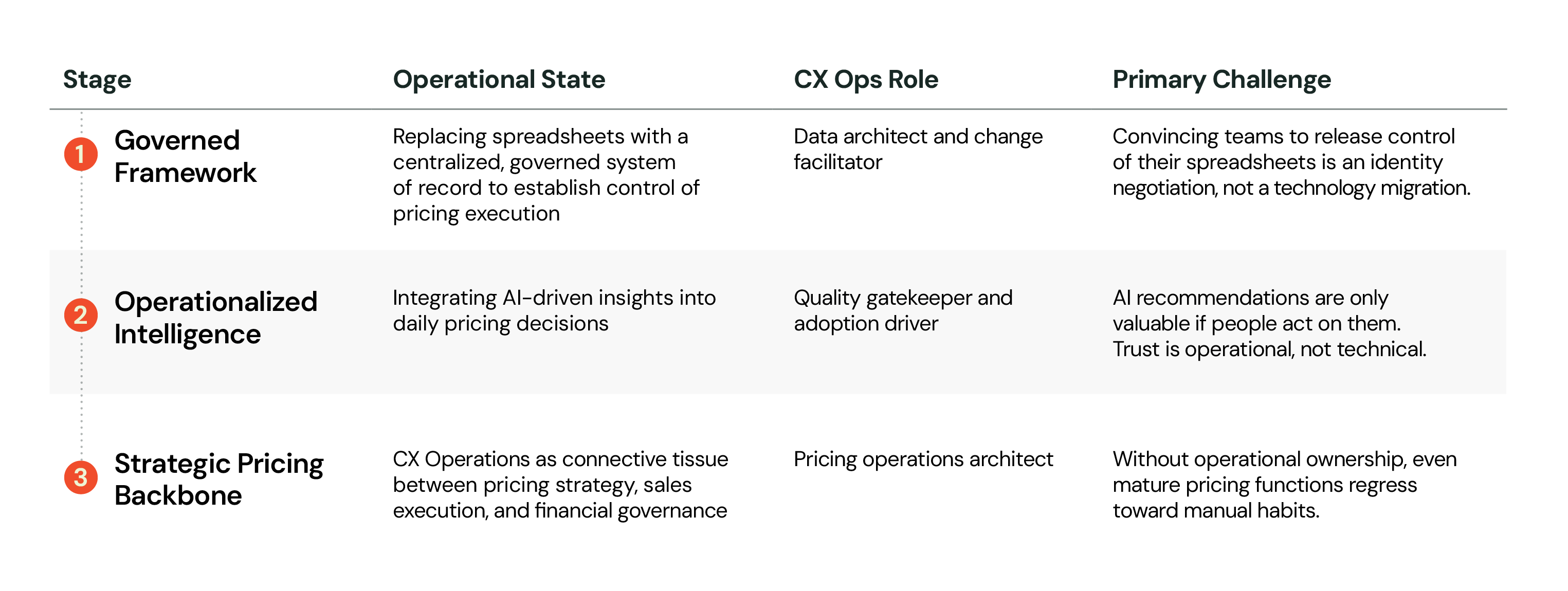
This is not a technology roadmap. It is an organizational one. Most pricing transformations are evaluated on technical milestones—data loaded, waterfall configured, prices published—while the operational and financial reality is far messier and far more consequential. The urgency is increasing as margin pressure, cost volatility, and competitive dynamics make inconsistent pricing execution more costly than ever.
Stage 1: What the First Phase Actually Looks Like
Stage 1 is where most B2B organizations begin and where implementations face their greatest risk. At this stage, pricing is often fragmented and inconsistently governed, increasing the risk of margin leakage and pricing variability. The technical objective is straightforward: retire key spreadsheets, align base prices in a governed framework, and establish a single source of truth. Pricing platforms designed for this stage of the journey can help organizations move quickly through a structured implementation path and embedded best practices. But even with a system that standardizes the pricing waterfall, the operational reality inside the organization introduces challenges that no software can automate away.
The spreadsheet inventory is larger than anyone admits.
Pricing logic typically lives across dozens of files maintained by different people with different conventions. Before anything is uploaded, CX Operations must conduct a pricing asset audit—mapping not just the files but the decision logic embedded in them. When an organization defines how prices are built from base cost through adjustments and overrides, that framework is only as coherent as the audit that precedes it.
Resistance is personal, not procedural.
The analyst who maintained a complex Excel model for years did not just create a spreadsheet—they created institutional value. Asking them to abandon it is asking them to redefine how they contribute. CX Operations must design the transition to preserve expertise while redirecting it: from data entry to data governance. This is where structured workflows and embedded best practices help. They give legacy experts a clear framework to operate within, rather than a blank canvas that feels like starting over.
Data readiness is never binary.
Waiting for perfect data is the most common reason Stage 1 stalls indefinitely. The CX Operations approach should be to define a minimum viable dataset, including core product records, account hierarchies, and recent transaction history, and build around that. Modern pricing platforms can reduce the technical barrier through capabilities like assisted data loading, field mapping, and guided configuration. But the discipline to scope the initial dataset correctly remains a judgment call that operations must own. Delaying progress in pursuit of perfect data often prolongs these risks rather than reducing them.
The first publish is a trust event, not a technical event.
When the organization publishes its first governed price set, the technical milestone is trivial. The organizational milestone is significant. CX Operations must orchestrate this carefully: ensuring stakeholders see their logic reflected, providing side-by-side comparisons against legacy outputs, and establishing escalation paths. Scenario modeling can support this process by allowing teams to draft and compare outcomes before committing to an active framework. That ability to test without risk is a critical trust-building mechanism. But the operations leader still needs to design the review cadence, assemble the right stakeholders, and create the conditions under which the team is willing to let go. It is also the point where organizations begin shifting toward controlled, measurable pricing execution.
Why This Matters Beyond Stage 1
The decisions made in Stage 1 determine the ceiling for both future capabilities and the organization’s ability to deliver consistent margin outcomes. A framework launched with incomplete data, unaddressed resistance, or without ownership of pricing execution will not support the AI-driven intelligence of Stage 2 or the strategic discipline of Stage 3. It will plateau—and the organization will quietly revert to the spreadsheets it never fully abandoned.
Making Pricing Maturity Stick
The first phase of pricing maturity is not about proving that software can work. It is about proving that the organization can operate differently. A structured implementation path can provide momentum, but those milestones only hold if someone inside the organization owns the execution between them—the stakeholder alignment, the change management, the data governance, and the feedback loops that turn a configured system into a functioning practice. That someone is CX Operations.
The software may be ready on day one. The organization rarely is. Pricing maturity must be measured from the operations perspective, not the technology perspective—because the person responsible for closing that gap is the one who determines whether transformation becomes permanent or temporary. Ultimately, pricing maturity is measured not by system adoption, but by the ability to control execution and drive consistent financial outcomes.
In the next post in this series, I will explore Stage 2: what happens when organizations begin integrating AI-driven pricing insights into their daily decisions—and why the trust infrastructure built in Stage 1 determines whether those insights are acted upon or ignored.
Akhil Radhakrishnan is a Lead Customer Experience Operations Manager specializing in B2B pricing software implementation. He leads cross-functional deployment of pricing lifecycle management platforms for manufacturing and distribution organizations, with a focus on driving adoption, data governance, and measurable margin improvement.