Medical device manufacturers are not losing margin in obvious ways. There is no single point of failure, no clear moment where things go wrong.
Margin loss is structural. And in many organizations, it is already embedded.
Most leadership teams still attribute margin pressure to the market. Pricing pressure, contract demands, channel dynamics. Those factors are real, but they are not the full story.
In reality, what looks like market pressure is often execution strain.
The Gap Between Strategy and Execution
Pricing strategy in medical device manufacturing has evolved. Most organizations have segmentation, value frameworks, and contract structures in place.
Execution has not kept pace.
As portfolios expand and routes to market become more complex, pricing decisions now span thousands of SKUs, multiple channels, and layers of agreements. The volume and variability of those decisions has increased dramatically.
What has not scaled at the same rate is control.
Pricing is still often executed across disconnected systems, manual processes, and localized decision making. The result is not a breakdown in strategy, but a breakdown in consistency.
What the Leak Map Shows
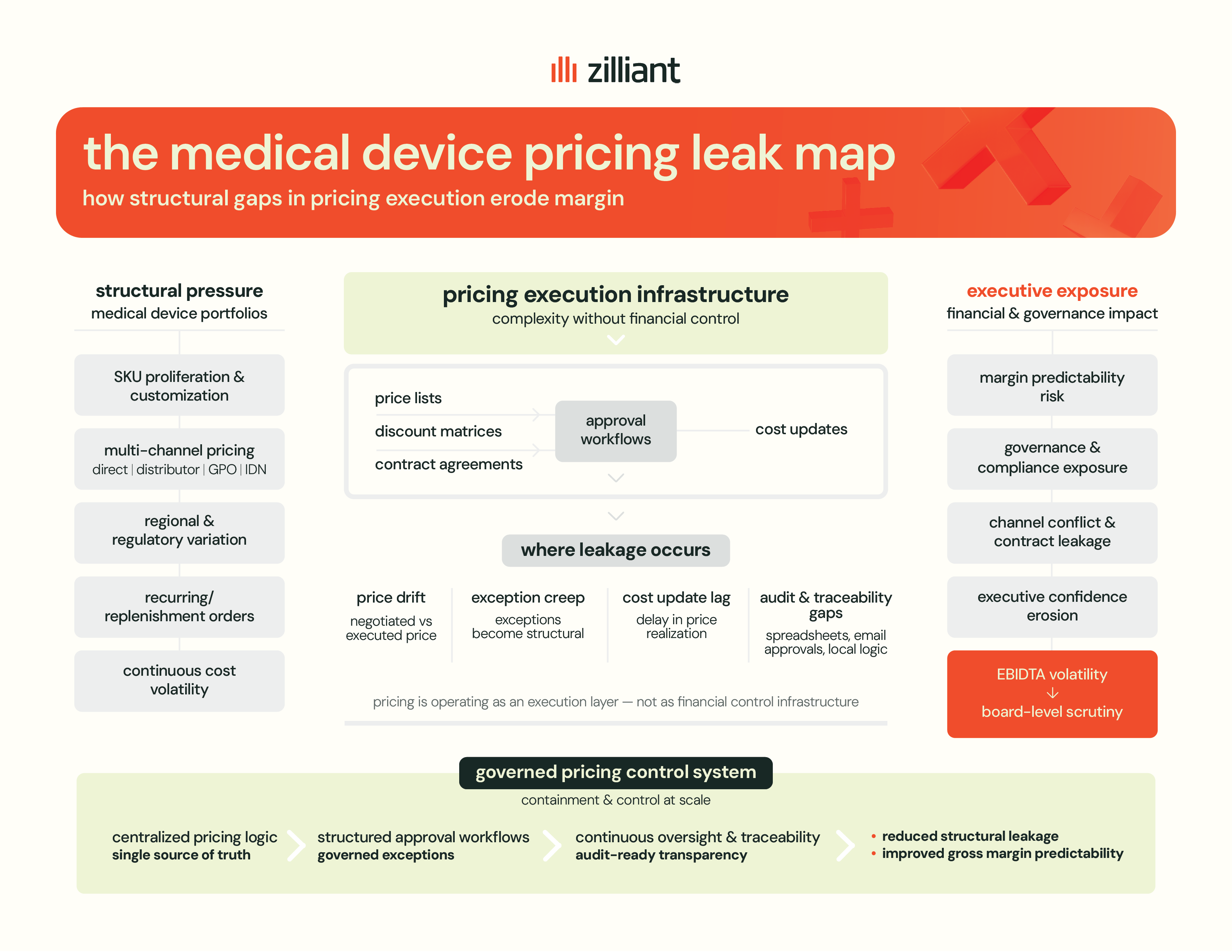
The Pricing Leak Map is not meant to explain every issue. It is meant to make one thing clear: margin erosion does not happen in one place.
It happens across the seams of execution. Across contracts, approvals, updates, and exceptions.
Individually, these moments seem manageable. Collectively, they create structural exposure.
Because the impact is distributed, it rarely shows up as a clear “leak.” Instead, it surfaces indirectly. Forecasts become less reliable. Margins compress without a clear root cause. Audit and compliance pressure increases. Confidence in pricing outcomes starts to erode.
This Is a Control Issue
At a certain level of complexity, pricing stops being just a commercial function.
It becomes part of the financial control system.
When execution is inconsistent or lacks governance, the consequences extend well beyond the pricing team. Margin predictability declines, compliance risk increases, and EBITDA volatility rises under greater executive scrutiny.
For medical device manufacturers, where regulatory and contractual requirements are high, the inability to explain how a price was formed is more than inefficiency. It is exposure.
The Shift Underway
The organizations getting ahead of this are not reworking pricing strategy. They are strengthening how pricing is executed.
They are moving toward centralized logic, structured workflows, and continuous oversight to contain structural leakage before it compounds.
This is what allows pricing to scale with complexity instead of breaking under it.
The Question to Ask Now
The leak map reflects how pricing behaves in complex, real-world environments. The critical question for leadership is whether pricing decisions can be consistently traced, explained, and defended across products, contracts, and channels.
If that level of visibility is not there, the risk is already embedded. Margin loss is not occurring in isolated events but through the accumulation of small, ungoverned decisions that compound over time.
Organizations that address this early can contain the impact and restore predictability, while those that do not will continue to see it surface as volatility, audit pressure, and declining confidence at the executive level.
If pricing decisions can’t be consistently explained, margin risk is already in play. Contact us to learn how Zilliant helps medical device manufacturers bring pricing under control: zilliant.com/contact-us